
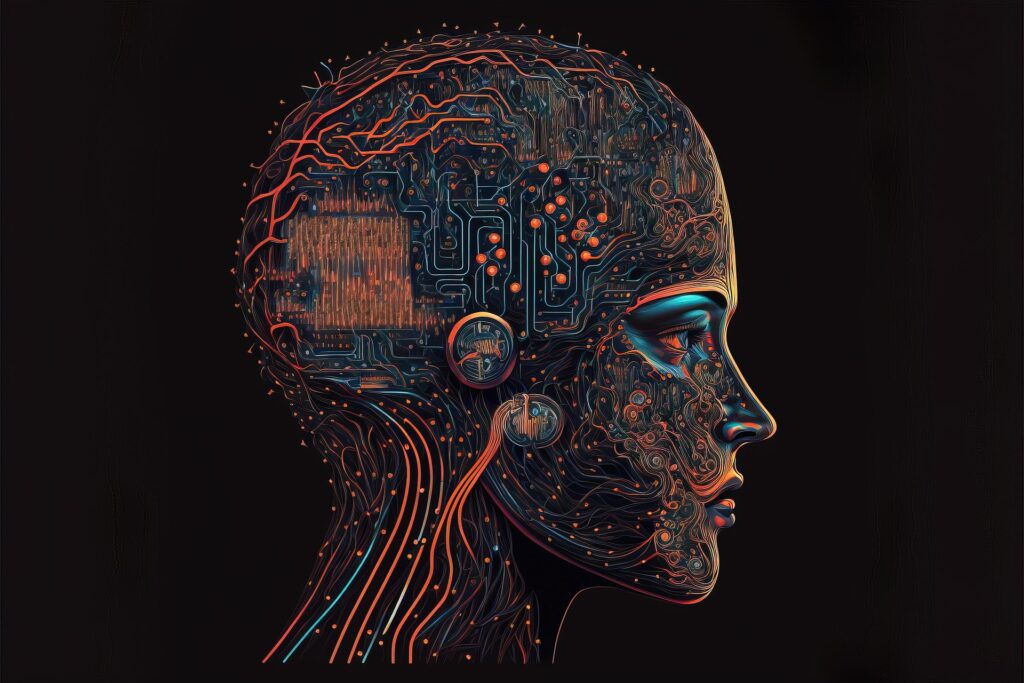

The course of human history is about to take a dynamic turn. For years, the narrative surrounding technology has been one of competition: man versus machine, labor versus logic. But that era is over. We have entered the age of co-intelligence, a paradigm shift where the most significant value isn’t created by a human alone or an AI alone, but by the synergy between the two.
In this revolution, we aren’t just using tools; we are engaging with partners. When AI and humans work in tandem, we unlock a level of potential that neither could achieve in isolation. This isn’t just about efficiency—it’s about a fundamental reimagining of what we can build, solve, and imagine.
What Is Co-Intelligence?
To me, co-intelligence is the collective power of human insight and machine processing. It is the bridge between our biological intuition and silicon-based speed. While many focus on “automation”—the act of a machine replacing a human task—co-intelligence focuses on collaboration.
Automation is about subtraction; co-intelligence is about multiplication. In a co-intelligent framework, human artificial intelligence becomes a unified decision-making engine. We provide the intent, the ethics, and the “why,” while AI provides the “how” at a scale that was previously impossible. This is the next evolution of work and creativity: a world where we lead, and AI amplifies.
The Evolution of AI and Humans Working Together
The journey to this point has been rapid. I remember when AI was nothing more than a series of rigid, rule-based “if-then” statements. It was helpful, sure, but it wasn’t a partner. With the advent of generative AI, the relationship shifted. We moved from giving commands to having conversations.
The fear of replacement, while understandable, is increasingly being replaced by the excitement of partnership. Looking at artificial intelligence and the future of humans, we see a history of milestones—from Deep Blue winning at chess to Large Language Models (LLMs) helping us write code. Each step has proven that AI doesn’t replace the human; it elevates the human to a higher level of operation.
Human Strengths vs Artificial Intelligence Capabilities
To master co-intelligence, we must acknowledge our different superpowers. Humans are the masters of empathy, ethics, and intuition. We understand context, culture, and the “gut feeling” that often drives breakthroughs. We bring the vision.
AI, on the other hand, excels at speed, scalability, and massive data processing. It can scan millions of documents in seconds to find a needle in a haystack. When we combine these, we create human artificial intelligence collaboration that is exponential. We use the AI to do the heavy lifting of data, freeing us to do the “heavy thinking” of strategy and emotional connection.
Real-World Examples of Co-Creation Between AI and Humans
We are already seeing this impact across every sector. In healthcare, doctors are using AI to analyze scans with higher accuracy than the human eye, but it is the doctor who provides the bedside manner and the final diagnostic judgment.
In creative industries, artists are using AI as a “digital sketchpad,” generating thousands of iterations to find one spark of genius that they then refine by hand. In business and marketing, AI identifies trends, but humans craft the brand story that resonates with the soul. Across education, we are seeing learning augmentation where AI tutors adapt to a student’s pace, while teachers focus on mentorship and inspiration.
Artificial Intelligence and the Future of Humans
I am often asked: “Will there be jobs left for us?” My answer is assertive: Yes, but they will look different. Jobs aren’t disappearing; they are evolving. We are seeing the emergence of “Prompt Engineers,” “AI Ethicists,” and “Human-Machine Orchestrators.”
The future belongs to those who develop human-AI literacy. We must upskill not just in technical terms, but in our ability to manage AI. Ethical considerations will be the guardrails of this future. We must ensure that as we integrate AI and humans, we maintain human agency and responsibility.
Co-Intelligence in Creativity and Innovation
In the realm of innovation, AI has become my favorite thinking partner. It acts as a sounding board that never gets tired. I can throw a half-baked idea at an AI, and it can provide ten different perspectives I hadn’t considered.
However, the machine has no vision. It doesn’t know what is “beautiful” or “meaningful” unless a human guides it. The most successful innovations of the next decade won’t be “AI-generated”—they will be human-envisioned and AI-executed.
Challenges in Human–Artificial Intelligence Collaboration
It isn’t all smooth sailing. We face significant hurdles, particularly regarding bias and data ethics. If we feed AI biased data, we get biased results. We also risk an “over-dependence” on these systems, where we stop questioning the output.
Trust and transparency are non-negotiable. For human artificial intelligence systems to work, we must be able to peek under the hood. We need to know why an AI made a suggestion. Balancing control is a delicate dance—we want the AI to be autonomous enough to be helpful, but not so autonomous that we lose the steering wheel.
How Individuals and Businesses Can Embrace Co-Intelligence
If you want to thrive in this new era, you must start with a mindset shift. Stop looking at AI as a threat and start looking at it as a cognitive exoskeleton.
- Audit your workflows: Where is the “drudge work” that AI can handle?
- Invest in literacy: Ensure your team knows how to prompt, verify, and iterate with AI.
- Prioritize Ethics: Establish a framework for ethical AI adoption from the outset.
- Focus on the “Human Plus”: Double down on the skills AI can’t replicate—leadership, strategy, and emotional intelligence.
The Road Ahead: A Shared Future of AI and Humans
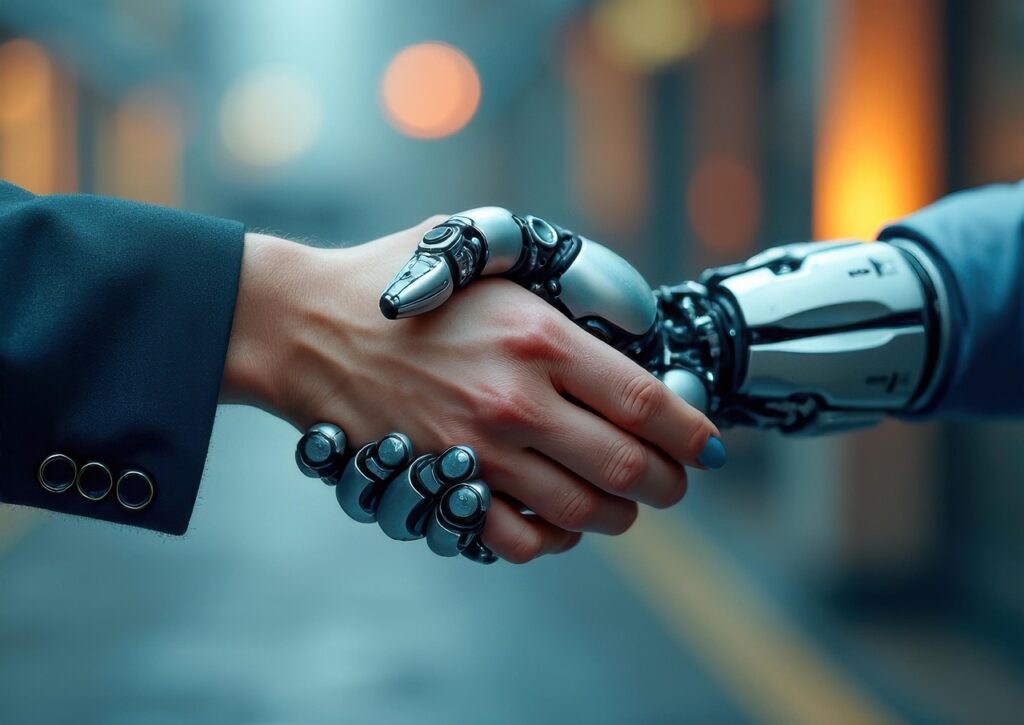
The road ahead is not a path toward a machine-led world, but toward a co-intelligent society. We are redefining what it means to be productive. Productivity is no longer about how many words you can type or how many lines of code you can write; it’s about the quality of the problems you choose to solve.
The artificial intelligence and the future of human narrative is ultimately one of hope. By offloading routine tasks to machines, we reclaim our time for purpose, creativity, and meaningful connections. We are not being replaced; we are being unburdened.
Conclusion
The Co-Intelligence Revolution is here, and it is the most exciting era in human history. By focusing on how AI and humans can co-create, we move beyond the limitations of our individual capabilities.
We must embrace human artificial intelligence collaboration as the standard, not the exception. The value we create together will be more than the sum of its parts. It will be a new kind of intelligence—one that is faster, smarter, and more human than ever before.

